
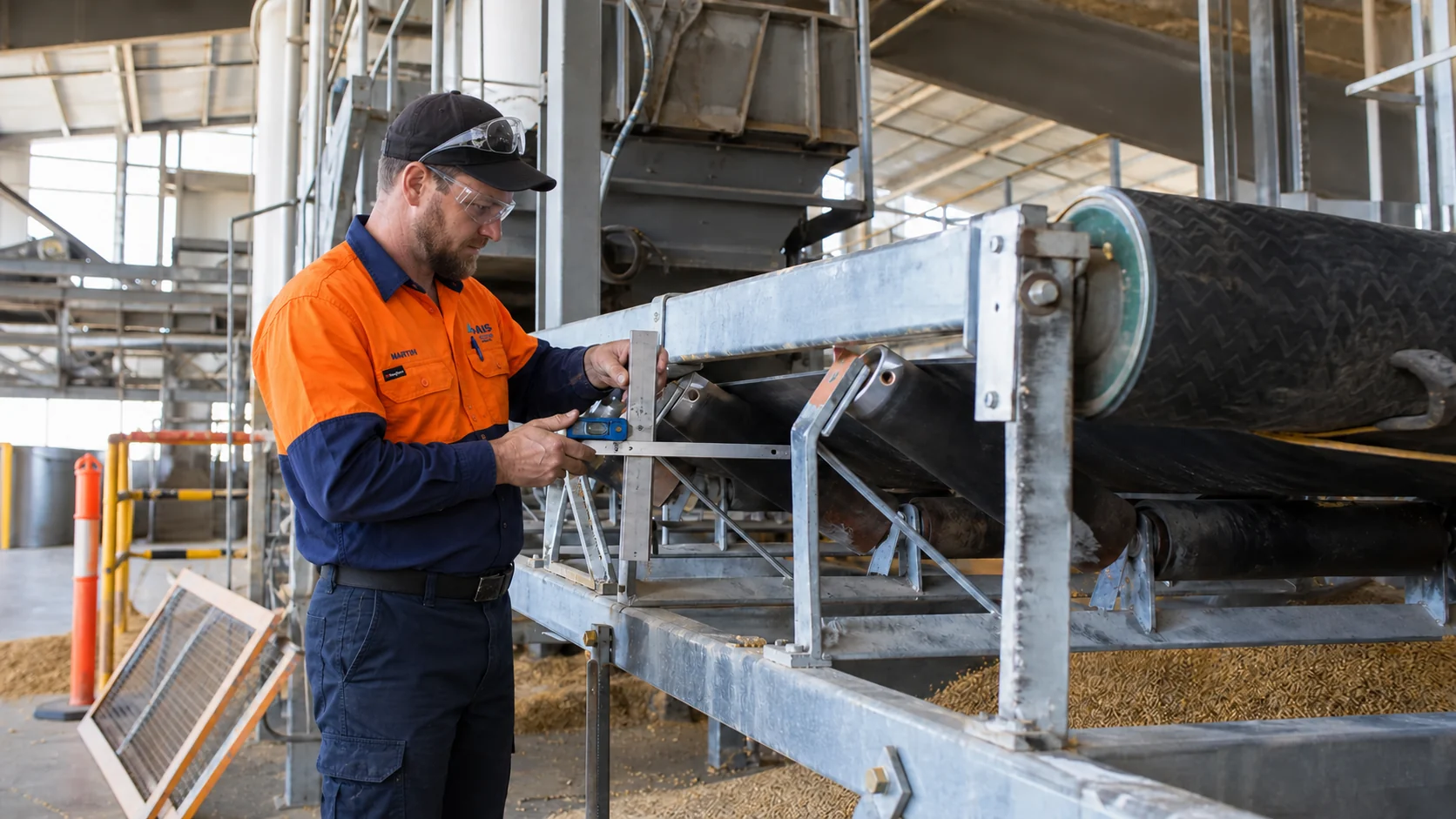
A belt that is continually trained back into position is signalling that another condition is still steering it away. Tracking is an outcome of belt condition, pulley and roller geometry, supporting structure, cleanliness and how the product lands. The useful diagnosis begins by observing when and where the movement starts.
01 / 03
Observe the pattern before making an adjustment
Record whether the belt moves under load, empty, after start-up, in one direction or with a particular product. Identify the first point where it departs from a stable path rather than focusing only on the location where it finally contacts an edge.
Inspect only under the site’s isolation and stored-energy controls. Tracking work around moving conveyors creates serious entanglement and crush hazards and must be planned accordingly.
02 / 03
Check the conveyor as one mechanical system
Confirm the supporting structure is sound and square before changing individual rollers. Look for seized bearings, product build-up, pulley condition, belt splice alignment, uneven tension and load points that place material off-centre. More than one condition may be contributing.
- 01Frame and pulley alignment
- 02Roller freedom and mounting condition
- 03Belt, splice and edge damage
- 04Cleanliness of return path and pulleys
- 05Product loading position and impact
03 / 03
Correct in a controlled sequence
Remove clear mechanical defects and contamination before applying small, documented training adjustments. Change one relevant condition at a time so the result can be observed and reversed if necessary.
Verify performance through the operating states that previously produced the problem. A short unloaded run does not prove a correction if the belt only wanders under production load.
If the belt repeatedly needs the same adjustment, treat that adjustment history as evidence of an unresolved cause.
The practical takeaway